POSTER BY
Joana Breidenbach
Board
Jul 20, 2026
What and who is the board?
The Board's formal role sits at the highest level of brafe.space's governance, it doesn't perform operational tasks. Management and the team organise the foundation's/GmbH's activities on their own responsibility and with the greatest possible freedom. As the highest governing body, the Board's role is a supervisory one: it exercises this function above all through legal transactions that require its approval, which is where the limits of operational decision-making freedom lie. The Board also appoints the foundation's management.
Beyond that, the Board is the organisation's most important strategic sensemaking body and is consulted before strategically significant decisions are made. Its advice isn't binding. The operational level has to take it seriously, but the decision itself stays with the operational team, except in cases that require the Board's legal approval.
Since brafe.space was founded, the Board has consisted of seven members: Rolf, Lisa, Corinna, Bettina, Joana, Wilfried and Holger. Anna, as Managing Director, also attends Board meetings.
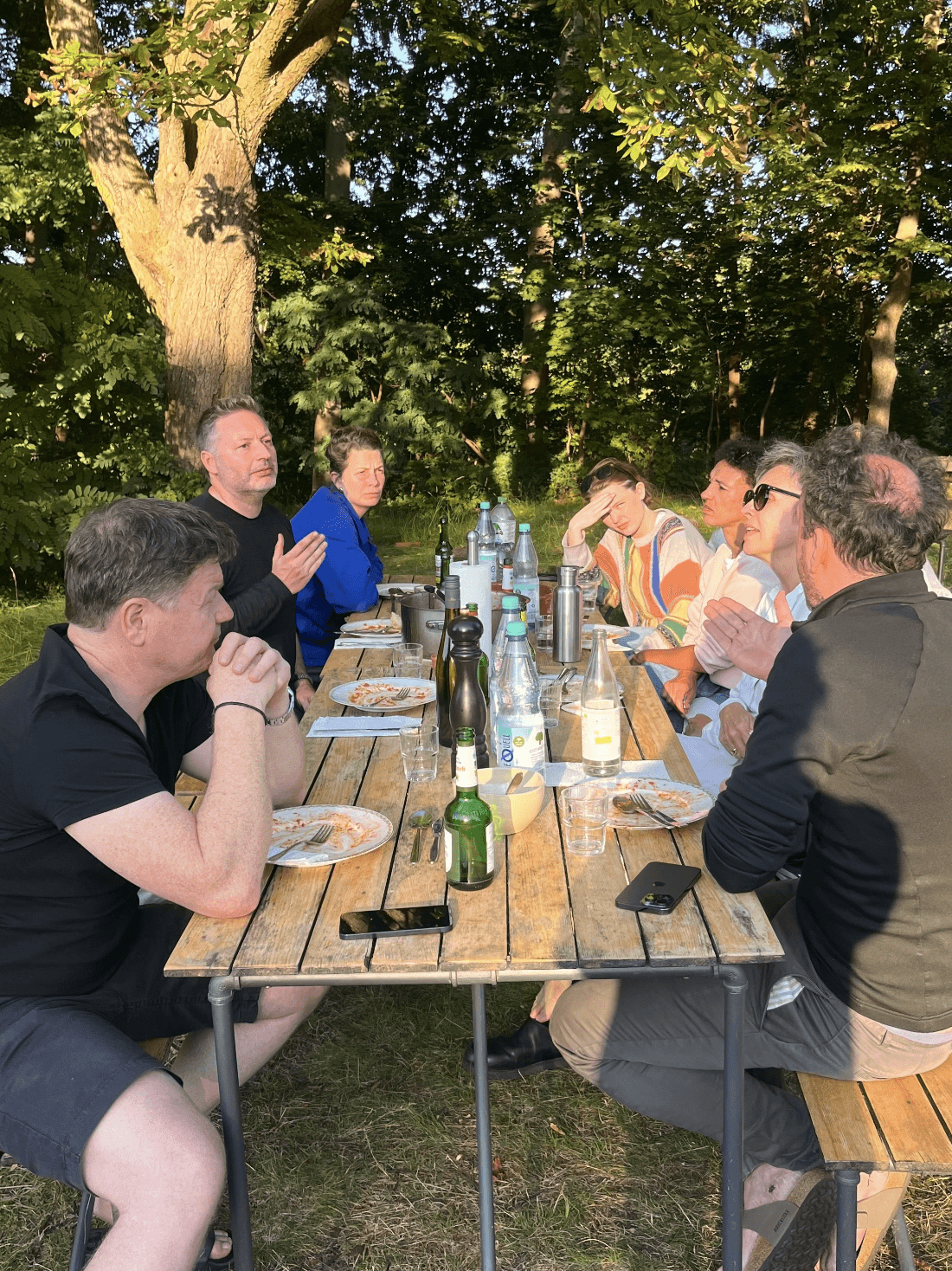
The Board meets every two weeks for a 90-minute meeting, where important matters are discussed with management. Board members have also committed to an additional monthly two-hour Circle session, and many take on further roles across brafe.space, as Circle hosts, for example, or with tasks around the annual camp, the enabling pot or the entrepreneurial ecosystem. They're closely involved in scouting and interviewing new members, and once a year, in early summer, they spend four to five days together at a board retreat, where they discuss and help guide the development of the community and the program.
As I described in another blog post, the board takes on a role of prefigurative leadership which means developing themes and relationships out of its own dynamics for the organisation as a whole.
You can read more about that here.
Everyone determines their own succession
Shortly after we started working together, we agreed that our roles would be temporary and that we'd step down again after a few years. When the brafe.space Foundation was established in autumn 2024, we wrote this into the articles of association (Satzung): each of us steps down after a maximum of five years and hands our seat to a successor.
We chose what might look like an unusual approach: each board member decides, independently and on their own responsibility, who their successor will be. It's not a group decision. That's not a concession to individual interests. It's a deliberate distribution of power. Experience shows that when a group decides on successors together, the most influential voices end up shaping the selection, and the group reproduces itself. When each member passes on their own seat instead, the power over the Board's composition is spread evenly across all seven of us. That's exactly what safeguards the diversity we want.
It also means no one is better placed to judge a successor than the person who chose them, and it keeps responsibility clearly assigned: whoever makes the decision is personally accountable for making it work. A group decision distributes responsibility until it belongs to no one.
In 2027, the first of us will rotate off and hand over our seat. That's what pushed us to work through the process in more detail, step by step. If two to three members leave each year, the Board will have turned over completely by 2029. We're assuming that each board member can contribute their most important ideas to the organisation within three to five years and that this careful but clear rhythm of transition lets brafe.space keep renewing itself.
The handover cycle
Here's how we plan the handover:
May: One or more outgoing members tell the Board they're stepping down, often at the Board retreat in France, and may already bring first ideas for a successor.
May /June: As laid out above and in the articles of association, the decision on succession rests with the outgoing member. At one of the fortnightly board meetings, they present their candidate, using the brafe.space criteria (here and below) as a reference point.
The Board discusses the choice. In an extreme case, it can exercise a veto: if 75 percent of the Board rejects the proposal (with the proposing member not voting) a new proposal is needed. We expect this to be a genuine last resort that's unlikely to come up in practice. The normal response to opposition is simply more conversation: board members get to know the candidate better, and either the Board's concerns are resolved or the member withdraws their proposal.
July /August: The outgoing member secures the successor's agreement. The successor needs a realistic picture of the time and responsibility the role involves. After that, the outgoing member and their successor can publicly announce the change.
January (the following year): At an onboarding workshop, the incoming member meets the Board for an in-depth chance to get to know one another and build trust, ideally followed the next day by the annual strategy day.
January to December: We aim for a smooth, committed handover that includes a full year. Individual deviations from this timeline can be agreed with the Board.
The new board member takes an active part in the fortnightly board sessions, the monthly board circles, and the France retreat in late April or early May, wherever possible alongside the outgoing member. Once the outgoing member formally leaves, their successor takes over with full voting rights, followed by the new board member's formal registration.
Five principles for choosing wisely
We also drafted a document laying out five cultural principles and questions which inform the search for our successor. These are not rules, but present a shared orientation, the qualities we have come to agree matter most, so that each free choice still strengthens the whole. No successor will sit perfectly with all five. The intention is simply that we make the choice with all five in view, and that we keep the foundation belonging to itself as the seats pass from one set of hands to the next.
1. Including more perspectives
Our purpose is to include more of ourselves, others, and our world. A board can only see as far as the perspectives sitting around the table. So with each new member the question is less whether they are diverse in the abstract, and more what they let us perceive that we currently cannot.
That can be a different entrepreneurial path, a different gender, a different social or cultural background, a different lived experience. Multiperspectivity is not a quota we fill. It is how a group makes better decisions on behalf of the whole.
The question we hold: What can the board see with this person that it cannot see without them?
2. Carrying the purpose
Because we lead through values rather than rules, everything depends on the people in the seats genuinely carrying the purpose: to include more, and to create space for entrepreneurs to evolve themselves, their organisations, and the world around them.
We are looking for people who hold this closely and protect it when it becomes inconvenient, while still thinking for themselves. Alignment here is about shared direction, not shared opinions.
The question we hold: Does this person carry the purpose, and would they protect it when it is costly?
3. Inner ground
The first of our three spaces is the space within ourselves, and we take it seriously in the people we choose. We look at how someone has worked on themselves: whether they can reflect honestly, stay with discomfort instead of reacting from ego or fear, hold a contradiction without resolving it too quickly, and think in systems and wholes rather than in parts.
This inner ground is what lets a person sit in a brafe.space, safe enough to stay open and brave enough to be honest. It is what allows a board to navigate complexity rather than flatten it.
The question we hold: Can they reflect, hold themselves under pressure, and stay with complexity?
4. Strengthening the field
A board is a relational field, not a collection of capable individuals. So we pay attention to what a person does to the field around them: whether they listen, build trust, and raise the quality of the shared thinking, and whether the group becomes stronger and more alive with them in it.
This is not about being easy or agreeable. It is the difference between people sitting in a room together and a board that can genuinely think together.
The question we hold: Does the group become stronger with this person in it?
5. Competency and commitment
We also ask what a new member can add to the group that is not yet there. That might be a competency in a field we do not currently represent, a particular reach, or the ability to represent brafe.space well to the outside world. A board is stronger when it holds capacities it was missing.
What matters, though, is not only that someone holds a competency, but that they can actually bring it in. A capacity that stays outside the room changes nothing, and competence is of little use without full commitment.
So this point asks for both at once: the competency itself, and the willingness to be fully present across all the formats we work in, so that the competency is brought in fully rather than held in reserve.
The question we hold: What competency does this person add, and will they be present enough, across our formats, to truly bring it in?
We are excited to pilot these processes and principles in the next months and years and to keep you informed of our learnings!